
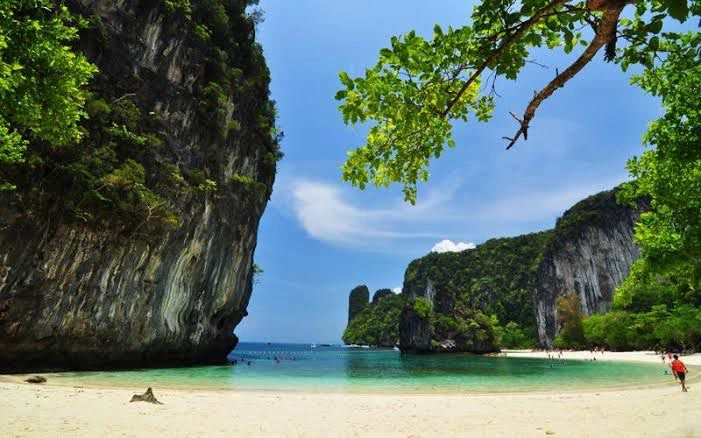
There are moments in Krabi when the landscape seems almost impossible. A vast rock wall rises from the sea, while a steep mountain shaped like a tower stands in the middle of a green plain. Trees hold onto cracks, caves open at the base of cliffs, and boats look tiny beside them.
How did these forms develop? To understand them, imagine a completely different world — one in which the material that now makes up the mountains accumulated on the floor of an ancient sea.
It began under water
Many of the area’s limestone cliffs are made from rocks dating to the Permian period, more than 250 million years ago. These limestones belong to a group known as the Ratburi Group, and some contain fossils of marine organisms, including corals and crinoids.
Limestone is composed mainly of calcium carbonate. In the sea, this material can accumulate through minerals settling from the water and through the skeletons and shells of living organisms. Over time, such sediments build up, compact and cement together into rock.
When we look at a limestone cliff, therefore, we are seeing material formed in an ancient marine environment — long before today’s familiar landscape existed.
How did the seabed reach such a height?
Earth’s crust is constantly moving. Across geological history, tectonic forces lifted and deformed rock layers, creating folds, faults and fractures.
Krabi’s limestone also preserves evidence of such movements. Research in the area has documented fracture systems related to the tectonic history of the Thai peninsula. These cracks matter because they allow water to enter the rock and begin changing it from within.
Water is the landscape’s great sculptor
Limestone looks hard and durable, but it slowly dissolves in mildly acidic water. Rainwater absorbs carbon dioxide from the air and soil, creating a weak acid capable of gradually dissolving the rock.
Water enters fractures, widens them and creates cavities and caves. A landscape shaped by this kind of dissolution is called karst.
In Krabi, the combination of rainfall, vegetation and suitable rock conditions allows these processes to act over very long periods. The same rain that sometimes accompanies our holiday is part of the story that created the landscape.
Why are towers left standing?
The rock does not weather uniformly. The arrangement of layers, fractures and water flow influences where dissolution and erosion proceed more quickly.
Over time, lower areas widen and deepen, leaving high, steep blocks of limestone between them. This landform is known as tower karst: the difference between the peaks and their surroundings grows partly because the material around them is gradually removed.
The same story, sometimes in the jungle and sometimes at sea
Changes in sea level and land elevation flooded parts of the Andaman coast’s karst landscape. Rising sea level after the last ice age contributed to this, turning some hills into islands.
That is why similar forms can be seen above both treetops and water. Along the coast, waves and weathering at the meeting point with the sea continue to shape the base of the cliffs.
What are the “curtains” hanging from the rock?
They may be stalactites and other cave deposits. When water carries dissolved limestone and deposits it again, mineral forms slowly develop: stalactites hanging from ceilings, stalagmites growing from floors, and sometimes columns connecting the two.
It is also useful to distinguish the age of the rock from the age of its present shape. The material can be hundreds of millions of years old, while the cliff, cave or island acquired its form during much later stages.
The next time you travel beside a Krabi cliff, look up. Imagine the ancient seabed, the movements that lifted it and the countless drops of water that have shaped it since. The landscape before you tells a long story of sea, stone and time — and we are privileged to see one moment of it.